

The Tag Propagation configuration transfers tags from architecture and planning sources to the technical interfaces that implement them, so business classifications are reflected across your technical landscape without manual re-tagging.
Purpose: Define propagation rules that copy a tag from a source interface type to a target interface type, making business context such as criticality, domain or lifecycle available on technical interfaces for filtering and reporting.
Navigate to Settings → Tags → Propagation to manage your propagation rules.
Tag Propagation Overview
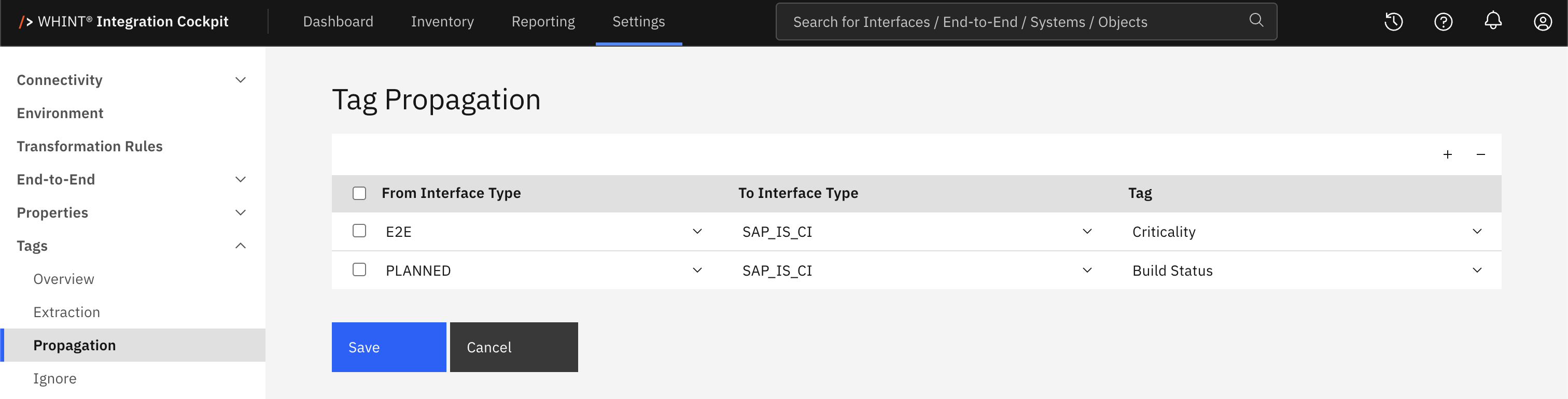
What you see in the interface:
-
From Interface Type column with dropdown selection for the source interface type
-
To Interface Type column with dropdown selection for the target interface type
-
Tag column with dropdown selection of your configured tag categories
-
Add/Remove controls (+ and - buttons) for managing propagation rules
-
Checkboxes for selecting rules
-
Save and Cancel buttons to apply or discard changes
Configuration and Management
Propagation Logic
Each rule consists of three elements:
-
From Interface Type – The source interface type providing the tag
-
To Interface Type – The target interface type receiving the tag
-
Tag – The tag category to be transferred
Tag propagation follows a top-down direction: tags flow from planning and architecture sources to technical interfaces. The available selections reflect this:
-
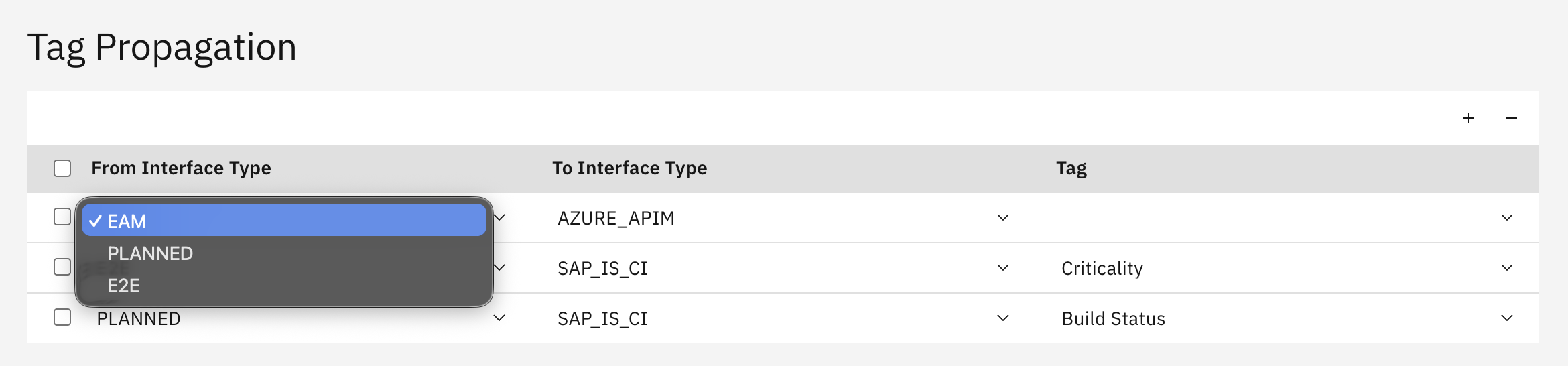
Source types are limited to EAM, PLANNED and E2E
-
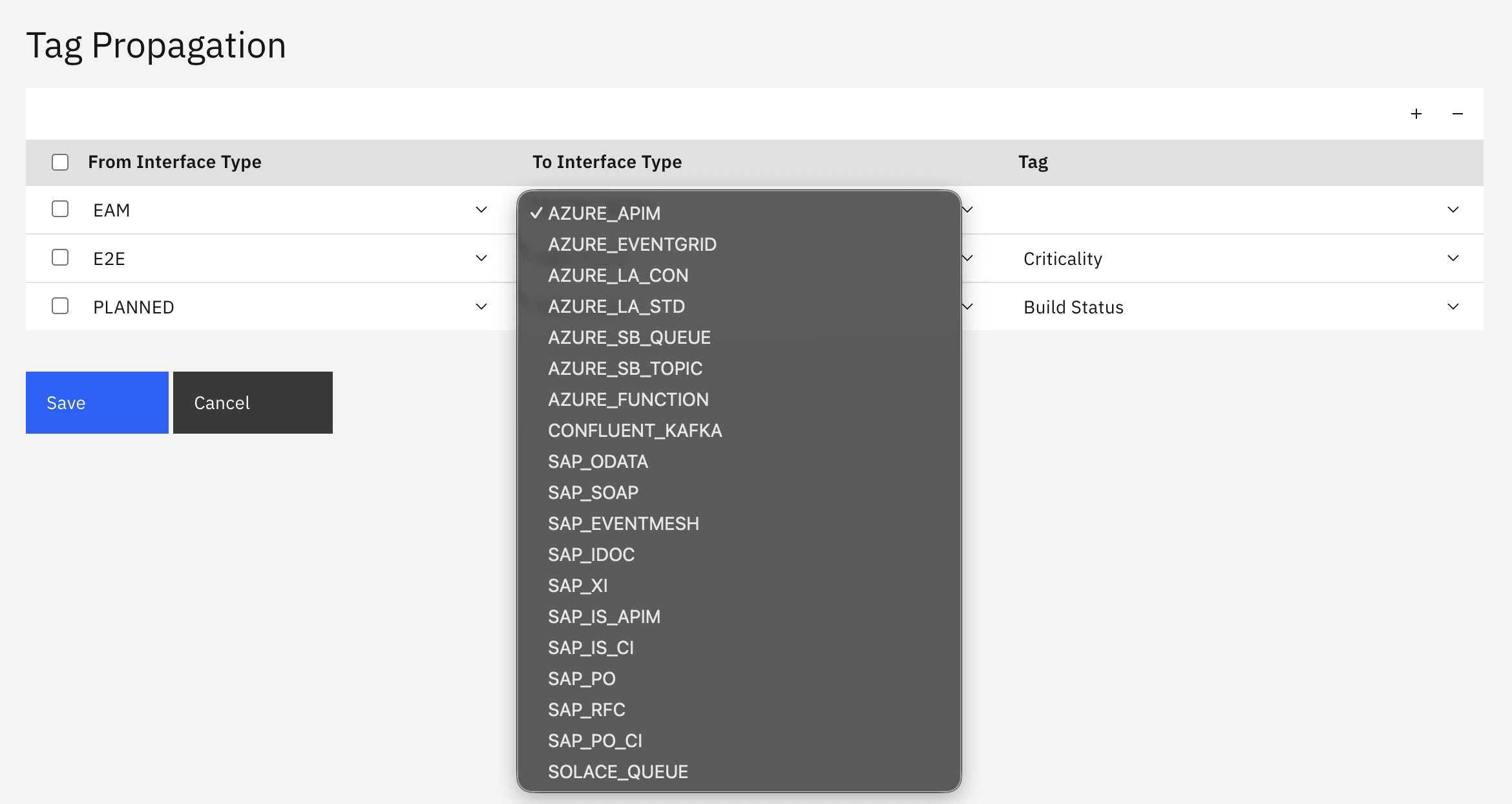
Target types are the technical interface types in your landscape, such as SAP_IS_CI, SAP_PO, AZURE_APIM or SOLACE_QUEUE
Interface Matching
To determine which target interfaces receive a tag, the system matches source and target interfaces in two stages:
-
By name – Interfaces with an identical name are matched first.
-
By identifier – Remaining interfaces are matched using a property with the ID format (for example GLIF-ID or Global Interface ID).
Only source interfaces that actually carry the configured tag are considered.
Conflict Handling
Tags from the source interface are merged into the target interface. If the target already carries the same tag category with a different value, the existing value is replaced by the value from the source.
Rule Management
Adding Propagation Rules
-
Click the "+" Add button to create a new rule.
-
A new empty row appears at the top of the table.
-
Select the From Interface Type from the dropdown.
-
Select the To Interface Type from the dropdown.
-
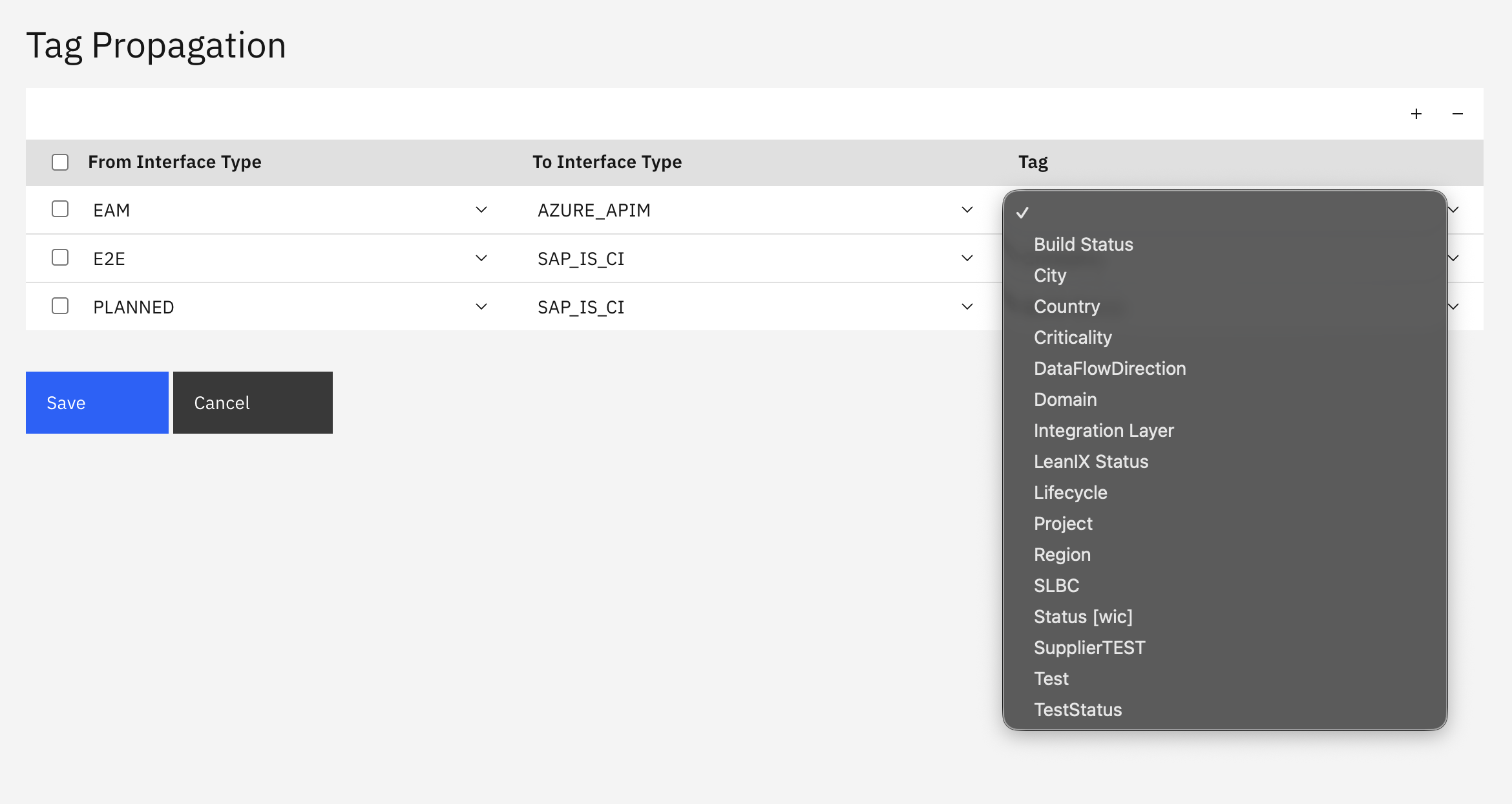
Select the Tag to be propagated from your configured tag categories.
-
Click Save to apply your rules.
Removing Propagation Rules
-
Select the checkbox next to the rules you want to remove.
-
Click the "-" button to delete the selected rules.
-
Click Save to confirm changes.
Usage and Implementation
Propagation rules are applied automatically during the CONFIGURATION task. No additional activation is required on data source level.
Implementation Workflow:
-
Create Tag categories and values first in Settings → Tags → Overview
-
Assign tags to your interfaces in the source system
-
Configure propagation rules using the source type, target type and tag
-
Run the CONFIGURATION job to apply the rules
-
Verify propagation in Inventory → Interfaces on the affected target interfaces
Once propagated, business classifications become available throughout Integration Cockpit for filtering interface catalogs, segmenting Dashboard metrics and enriching Excel exports.
Quick Tip
Propagate classification tags such as Criticality or Domain from your EAM or planning source, rather than maintaining them per technical interface. Ensure a consistent naming convention or a shared ID property across systems, as these are what the matching relies on.
Requirements and Setup
Prerequisites:
-
Tags configured in Settings → Tags → Overview before defining propagation rules. The Tag dropdown shows all available tag categories from your Tags configuration.
-
Matching criteria in place — either identical interface names across source and target, or a shared property with ID format
-
Source interfaces tagged in the leading system
Technical Requirements:
-
CONFIGURATION job execution to apply propagation rules
-
Data source connectivity for both the source and target platforms
Related Documentation
For comprehensive tag and property configuration guidance:
-
Tags – Complete tag reference and usage examples
-
Property Propagation – Transfer of property values between interface types
-
Transformation Rules – Automated tag and property assignment during data source processing
Last Updated: August 21, 2026